Sunday, 24 March 2013

Assignment 2: Reflections

Elegy and Reflections for Solo Oboe

I wanted to write a piece in ABCA form with the following principle - the music begins sorrowful with someone mourning the passing of a loved one. The person then begins to reflect on the happy times they shared, so a more upbeat, bright passage is required. This then leads to a more aggressive, animated passage where things start to go wrong and something tragic happens; a death or a break up. The sorrowful, morning mood returns to end the piece.

I thought the first motif I wrote for the Bassoon East European Minor Scale piece as part of Project 7 would make a good starting point for the sorrowful, mourning melody. I decided to write for oboe as I thought the tone of the oboe in the upper register would suit the mood I was trying to create. I transposed the minor version of the East European scale provided in example 25 up a fourth so that the 3 notes a semi-tone apart were focused around a D so that it was in the right part of the oboe’s upper register; Poulenc uses this part of the oboe’s register to superb effect in the third movement of his oboe sonata to create a very passionate, mournful melody. To aid writing I set a key signature of D Major so that the only accidental that needed to be added was an Eb; I used the Eb’s as focus points because it is the only note which doesn't fit into a D Major scale. Bars 5-9 are designed to create more of a major feel to the melody; it’s loosely based on a flute solo from Shostakovich’s 5th symphony, 3rd movement (bar 94). The final phrase of the lento passage was written to sound as though the melody resolved into D Major, creating the impression of a positive outcome to the situation to aid the transition to the next section.

From working on Project 7 I found the nine-note scales quite easy to work with; the extra chromatic notes allow a few different keys to be explored. I decided to use the scale in the left hand side in example 25, but with a Bb; this allowed the keys of F and Bb Major and G minor to be employed. I recently sang Schubert’s Mass in Ab flat where he frequently modulates to the flattened submediant to very good effect. Using this idea, I was able to modulate from D Major at the end of the first section to Bb Major at the beginning of the second section. I wrote it in 6/8 to give it a dancing feel, with the melodic line emphasising the beat; I also set it lower in the oboe’s register so that a fuller, more rounded tone would be possible. Using ideas from Phaeton (six metamorphoses after Ovid) I added rests to some of the groups towards the end to add a sense of unease and uncertainty. The music modulates from Bb Major to F Major before the last line of the section sees the introduction of F#s to introduce G minor and the transition into the next section.

I used the chromatic scale to create an agitated feel to the third section as it loses the sense on tonality. The section from bar 39 to 44 is based around a rising sequence, but with rests interspersed at different points to make it sound uneasy.  Whilst this passage requires quite a lot of skill and dexterity I don’t think it is outside the realms of a good oboe player. The section ends on a held top D which allows a return of the opening music. The opening two phrases return, but are heavily ornamented with particular emphasis on the Ebs; Debussy’s Syrinx was the inspiration for this. I add a low B to the end of the second phrase to give it a rawer, edgy ending. The phrases return in their unornamented form, with the added bottom B again before the last phrase of the first section ends the piece, but it ends on an Eb rather than a D so that it doesn't sound like a natural resting point or ending, as though there is some unfinished business. 

Project 7: Exploring Different Scales

Flute Whole-Tone Scale

I wanted to use the dexterity of the flute to shape the melody, but found the whole tone scale quite limiting to work with as there are a limited number of intervals you can actually use.


Treble Recorder Whole-Tone Scale

I wrote this with a Renaissance dance in mind, but the whole tone scale gives it a distorted, spooky feel which I think works quite effectively.


Oboe East European Major Scale

I found it difficult to use this scale and keep a feel of major tonality to it. I tried to use different parts of the oboe's register to colour the melody.


Bassoon East European Minor Scale

I wrote this as 2 similar phrases; one very high in the bassoon's register, the other towards the bottom. I felt this scale had much more of a minor feel to it than the previous one.


Clarinet Middle Eastern Eight-Note Scale

I found this scale difficult to write in because it has no real sense of tonality to it; it is hard to tell whether it is major or minor. 


Tenor Saxophone Middle Eastern Eight-Note Scale

Like the previous piece, I found this scale quite difficult to write in as I struggled to fit what I wanted into the notes available. 


Flute Nine-Note Scale

I based the first phrase loosely on a dominant seventh in the key of C, but the final scales at the end create the impression the piece ends in E Major. The extra chromatic notes in the scale were useful in ornamenting the melodic line.


Oboe Nine-Note Scale

I noticed that, from the notes of the scale, you could write a melody in either A Major or A minor so this is what I did; the first phrase is in A Major, the second is the same in A minor but the ending gives a feel of finishing in G Major.


Clarinet Chromatic Scale

I actually found this the easiest to write, mainly because I just used rising and descending chromatic scales for most of it and didn't need to constantly check the notes to see whether they belonged to the scale. 

Project 6: Analysing a Solo Composition

My rational behind choosing these two pieces was very simple - they are the two pieces listed in the course notes that I had sheet copies of at home.


Syrinx - Claude Debussy (Flute)

This was the piece I played as my solo study for my Grade 8; 12 years ago. What amazed me the most about this piece when I got the score was that it's 8 pages long, but the music only fills the first 2; the remaining 6 pages are performance notes and a background to the setting of La Flûte de Pan. The piece was requested by Gabriel Mourey as incidental music to his play Psyché, to be performed as the last melody the character Pan plays before his death. As a result, the music contains the lines spoken on stage in between the musical lines.

In general the music has a very chromatic feel to it; Debussy also only tends to use the bottom 2 octaves of the flute's register as the brightness of the top register is not really in keeping with the mood of the music. Throughout the piece Debussy is very precise about how the rhythms should be played and the tempo of the music; he regularly marked where the music should have more movement, where it should slow and even where rubato should be employed. His dynamics are also very precise; in many cases he marks crescendos and decrescendos to indicate emphasis in a musical phrase rather than actually meaning get louder and softer. He also never marks the music louder than mf, meaning everything is slightly restrained.

The opening melody features emphasised dotted quavers interjected with demisemiquavers which create the feeling of mordents leading into the next note. Debussy then uses a rising triplet motif to create a sense of movement and building before the section ends with long, sustained high notes. A paused bar denotes words spoken on stage before the opening motif returns an octave lower and piano. Some scalic flurries lead into the next section based around triplet groups low in the flute register. Setting it this low gives a tone of mystery and mourning. The same triplet group begins each phrase followed by a different short motif; it's as though Pan is reminiscing about something, but by repeating the same motif with a different ending it creates a feeling of uncertainty. The music then becomes more animated, as directed by Debussy, but aided by rising and falling semiquaver triplets.

Rising trills lead to the return of the opening motif with different embellishment from before. The notes of this motif are then repeated down an octave but with a triplet rhythm, making it sound sleepier than before. The triplet groups of the middle section return, but with long held notes in between so that it loses the fluidity it had before. One final piano, descending scale leads to a bottom D to finish the music, marked perdendosi (dying away) to represent the passing of Pan.


Six Metamorphases after Ovid - Benjamin Britten (Oboe)

If I had remembered I had this at home I'd have selected a different oboe piece for the study point, but hindsight's a wonderful thing. Like in Syrinx, Britten provides a short description of each movement to set the mood.

I. Pan - who played upon the reed pipe which was Syrinx, his beloved.

The movement is marked Senza misura, meaning without measure; Britten doesn't specify a time signature and only uses bar lines to denote breaks between phrases. The phrases at the beginning are short, only a few beats long, and tend to start and end on the same or notes close to one another; the melodic line simply turns around the starting notes. Britten varies the number of notes he groups together so that the melody arrives at his desired note on the beat; groups of 5, 6 and 7 are used. A second section begins pianissimo with repeated notes followed by a rising and falling section. This theme is repeated a few times with embellishment on the rising and falling motifs until a rising sequence with a crescendo leads to the same repeated notes up an octave; it's interesting how effective repeating the same note is in building or tapering the musical line. The final section uses demisemiquavers in front of dotted quavers to ornament the notes of the melodic line and create a feel of uncertainty and almost panic; the music crescendos and accelerates to a final trill before two phrases reminiscent of the earlier passages end the movement.


II. Phaeton - who Rode upon the chariot of the sun for one day and was hurled into the river Padus by a thunderbolt.

The movement is set in 12/8 time and the opening melody is reminiscent of a gigue, except Britten puts rests on the 3 note of some groups to make it sound less secure; this creates the impression Phaeton is slightly out of control on his chariot. The notes are short and detached to create a contrast with the previous movement. After a pause the music continues with a similar motif a fourth higher but slurred in different groups to create a smoother melodic line, yet still with rests at the end of some groups breaking up the melodic line. The detached version of the motif returns followed by a descending, crescendoing chromatic scale down to a fortissimo Bb, the lowest note on the oboe. This section is to symbolise Phaeton soaring too high before plummeting to earth. The loud, low passages which follow suit the oboe very well as it creates a raw, edgy tone.


III. Niobe - who, lamenting the death of her fourteen children, was turned into a mountain. 

Marked Andante piangendo, meaning weeping, this movement contrasts the previous movement being much slower and more restrained. Overall it is set high in the oboe register, which gives it a pained tone in keeping with the meaning in the title. The music features a lot of descending phrases; the opening motif is particularly poignant as Britten writes a dotted crochet-quaver pattern with stress on the dotted crochet to create a motif which dies away as it descends onto the quaver. The middle passage becomes more animated and lively with slurred triplet motifs built around rising and failing arpeggios; I get the impression this passage is meant to symbolise Niobe's transformation into a mountain as it completely breaks the mood of the previous section. The opening music then returns but piano, decrescendoing to pianissimo before rising to a top D to create a weak, feeble ending to the movement.


IV. Bacchus - at whose feasts is heard the noise of gaggling women's tattling tongues and shouting out of boys.

This movement is roughly laid out in an ABAC form. My interpretation is that the A section gives the setting of the feast, almost like incidental music to be played while the guests are eating. The dotted quaver-semiquaver grouping which forms the basis of the melody gives it a grand, pompous feeling. Each group is slurred together to give it a bouncy feeling and this is interjected with detached semiquaver groups. There is a suggestion that the music is set in 4/4 time, but in the opening section there are regularly bars with only 3 beats in them, thus Britten is able to vary the number of dotted quaver-semiquaver groups he uses in a bar. The B section I think is meant to symbolise the gaggling women; it features large rising leaps in the melodic line and detached semiquavers to create a more edgy, biting feel to the melody. One beat, or longer, rests are interspersed to create a break in the proceedings, as though the women are pausing for thought. The C section I think symbolises the boys shouting. Breaking away from the previous sections it is marked con moto and uses long semiquaver broken chords to give a feeling of fluidity and agitation. The passage ends on repeated sforzando Cs, creating a feeling of anger and power as though the boys are being told off. A variation of the opening music then returns to end the movement.


V. Narcissus - who fell in love with his own image and became a flower.

This movement, marked Lento piacevole meaning slow and pleasant, fits perfectly with the tranquil fixation of the title character. Britten uses written out trill motifs to ornament the melodic line. As the movement progresses he begins to write some of the notes with upward stems and some with downward stems; he notes the upward stems represent the reflected image of Narcissus, and the downward stems represent Narcissus himself. Britten writes the passages with upward stems roughly an octave high than the downward stems and the music generally echoes the preceding motif but inverted, like a reflection. Listening to the music, it is sometimes difficult to appreciate that it is written like this as there is no dynamic contrast between the motifs. This might be intentional though, as Narcissus became so infatuated with his own image he lost sight of what was real.


VI. Arethusa - who, flying from the love of Alpheus the river god, was turned into a fountain.

This movement is written with rising and descending arpeggios to depict flowing water. Britten puts emphasis on the first note of every group to mark the melodic line out of the semiquavers; the rest of the notes are then slurred to create one long, flowing group. The middle passage is very different; Britten uses trills on every note to create a feeling of movement through the descending melodic lines.

Wednesday, 27 February 2013

Introducing Wind Instruments - Francis Poulenc

Another way I thought of investigating the characters of the different woodwind instruments is though the works of Francis Poulenc. Poulenc wrote 3 sonatas for solo woodwind and piano. He had planned to write a complete set of woodwind sonatas, but he died shortly after the completion of his third; the oboe sonata. The other 2 works are the flute sonata (1956-7) and the clarinet sonata (1962). He did, however, also write other chamber music works for woodwind; a sonata for clarinet and bassoon, a trio for oboe, bassoon and piano and a sextet for piano and wind quintet (flute, oboe, clarinet, bassoon and horn).


Sextet for Piano and Wind Quintet (1932–9)

The sextet for piano and wind quintet is an interesting piece because it shows off Poulenc’s awareness of the strengths and weaknesses of the different wind instruments. It’s a virtuoso piece for all the instruments and shows them all off in equal light. It’s written in three movements in a fast-slow-fast form, though each movement has a middle section which changes mood.

The first movement begins loud and boisterously, with short injections from each instrument. Here Poulenc plays around with pairing different instruments; solo lines are interspersed with duet lines for flute and bassoon, flute and clarinet, clarinet and bassoon and oboe and bassoon. The horn injects with fanfare style calls before the music eventually settles down with a flute melody that is echoed around the different instruments, interjected with rapid scales and different playing techniques such as trills and flutter tonguing. Again, loud horn interjections break the mood before a calm, smooth bassoon cadenza joins into the slower middle section, which begins with a piano solo. A slow oboe lament is shared around the instruments, first with a very low flute solo which creates a very sombre mood. By contrast the horn solo which follows, whilst quiet and contained, sounds more defiant and emphatic. The oboe returns, accompanied by a bassoon counter melody. The horn and clarinet exchange melodic lines with the other instruments playing long sustained notes to add to the texture. By changing the melodic line between instruments the mood and colour of the line changes whilst maintaining a quiet dynamic. The texture gradually builds with more instruments being added; Poulenc uses the more dexterous instruments like the flute and clarinet to embellish the texture with rapid scales and arpeggios around the other parts. A staccato bassoon and piano line under a long oboe line sees a change in style which introduces a return to the opening theme; the bassoon and oboe blend well together although their material is of a contrasting style. This time the theme is in a different key and subtly different instrumentation is used to change the sound of the music. A short coda passage then ends the movement.

The second movement begins with a long, smooth melodic line played by the oboe, accompanied by the piano and bassoon and horn chords. This is taken over by the clarinet and horn while the other instruments play long sustained chords. The bassoon and flute continue the melody before trills from the clarinet and oboe make the music more animated. The texture and dynamic build before the piano and bassoon accelerate into the faster middle section. The horn and flute exchange melodic lines before the clarinet and oboe play a vibrant duet over a bassoon trill. A further vibrant duet from the flute and clarinet high in their register show how well the 2 instruments can blend together. The thematic material is shared around other instruments while additional bits of texture are added, such as rapid flute scales, sustained chords and trills. The music gradually becomes more gentle and sustained, seeing a return to the style of the opening. Again, the pairing of the flute and bassoon returns, which is remarkably effective considering they can be playing over 2 octaves apart.

The opening of third movement is much like the first, with loud, short sharp interjections from different instruments accompanied by staccato chords and clarinet and flute flourishes. The music eventually settles with smooth flowing melodies under a mobile piano accompaniment. This is met by a sudden staccato horn melody, echoed low on the clarinet showing off the power of both instruments lower registers. The bassoon and oboe continue the theme, but their more nasal tone changes the colour of the music, creating a good contrast to the horn and clarinet pairing. Motifs reminiscent of the first movement are added by the flute and oboe along with an emphatic, trumpet like horn solo below dissonant sustained chords from the other wind instruments. The opening material then returns, but like the first movement Poulenc subtly changes the instrumentation to change the sound of the music, even adding a hand stopped passage of the horn to spice things up. The movement ends with a slower, reflective passage similar to the middle passage of the first movement. This builds in dynamic, becoming more dissonant as more instruments are added to the texture. Long but separated chords build in dynamic until one final staccato chord ends the piece. Here Poulenc shows how effectively you can build chords with wind instruments, either short or sustained, and by changing where the instrument is in the chord you can change the sound of it.


Flute Sonata (1956-7)

The flute sonata was composed for the French flautist Jean-Pierre Rampal, considered by many to be the greatest flautist of the 20th century. The piece is written in three movements in a fast-slow-fast form.

The first movement features smooth flowing melodies whilst at the same time showing off the dexterity of the instrument; trills and rapid tonguing are both required. He uses the same melody in different registers to show off the difference in tone of the instrument; the purity and clearness of tone in the upper register contrasting the weaker, more restrained lower register. He also uses a large dynamic contrast, particularly in the upper register, to change the mood; he writes passages in a lower register which are echoed later in the upper register.

The second movement features long, flowing melodies but with a more sorrowful mood; the title of the movement, Cantilena, literally translates as 'song'. Poulenc utilises the clarity of the upper register to create a very pure sounding melody, which when performed with little or no vibrato creates a mood of absolute calm and stillness. The character changes for a short middle massage which becomes more agitated. A long, loud low note shows off the harshness available in the flute lower register; a contrast to the two high lines either side of it. The music becomes more animated and agitated, building to a climax on a high trill, before the returning to the opening thematic material and mood; this time it is even quieter and more reflective showing the dynamic range of the instrument.

The final movement is upbeat and virtuosic, again showing off dexterity of the instrument, in particular the extremities of range that can be covered quickly. Much of the movement is at the top of the flute’s range, showing the ability it has to pierce through a texture at that pitch. Again, Poulenc uses are large dynamic range throughout the flute’s register. A reflective slower passage sees a return of a theme from of the first movement before the opening returns for a dramatic ending to the piece.


Clarinet Sonata (1962)

The clarinet sonata was dedicated to the composer Arthur Honegger, a fellow member of ‘Les Six’. It shares the same form as the flute sonata - three movements in a fast-slow-fast form.

The first movement begins very much like the first movement of the flute sonata; some of the melodic lines are very similar to those in the flute sonata. Like the flute sonata, the melody uses a lot of the clarinet’s range, showing the evenness of tone that can be achieved throughout the instrument; many of the melodies are made up of motifs based around ascending and descending broken chords and arpeggios. It also shows off well the large dynamic range the instrument has. The slower middle section of the movement features longer, more flowing themes, with a melodic line reminiscing of the orchestral opening of the ‘Domine Deus’ from the composer’s Gloria. A final reprise of some of the opening themes ends the movement, but generally quieter and more reflective.

The slow second movement has a more sombre feel. Again, there are echoes of melodic ideas from the 2nd movement of the flute sonata, but in general the melodic line is more elaborate; long phrases joined by rapid scales and arpeggios showing the dexterity and even tone of the instrument. The melodic line uses the extreme top end of the clarinet’s range, but Poulenc uses this to emphasise moments of extreme hurt; the loud high passages make it sound as though the instruments is crying out in pain, in contrast to the pianissimo lower passages.   

Like the flute sonata the third movement is lively and energetic, featuring a rapidly moving melodic line and trills making it sound almost jokey and childlike. It also features smoother, quiet, reflective movements amongst the chaos. Like the first movement, this shows the dexterity of the instrument throughout the whole of its vast range and the large range of dynamic contrast available. 


Oboe Sonata (1962)

Unlike the flute and clarinet sonatas, the oboe sonata has three movements in a slow-fast-slow form, producing a more melancholy, sorrowful piece which suits the oboe particularly well; Poulenc dedicated the piece to his friend Sergei Prokofiev who had died in 1953.

In the first movement, Poulenc uses the contrasting tone quality of the oboe’s upper and lower register to reflect the mood of the music; he writes soft, reflective high passages to match the instrument’s sweet tones in the register. He then uses the lower register to produce a fuller, stronger tone to the melody. The music allows the lower melodies to sound confident and resonant, whilst the higher writing sounds more reflective and pensive.  The long, flowing melodic lines show the clearness the oboe can achieve; due to the resistant the double reed provides the oboe can achieve vast feats of endurance compared to other woodwind instruments. There are also moments where the melody is reminiscent of the middle section of the first movement of the clarinet concerto.

In contrast the second movement, 'scherzo', features more staccato, attacking lines to show off the raw, raspy quality of the oboe, particularly in the upper register. Again, Poulenc writes over a large range and shows of the dexterity of the instrument. The slower middle section is more reminiscing of the first movement; a return to long flowing lines.

The concluding lament (‘Déploration’) is particularly suited to the qualities of the oboe. Like the first movement, he writes high and low melodic lines to change the mood; at the extreme lower end of the oboe register he achieves a very raw, powerful sound. This phrase occurs twice; once loud and once very quietly to show off the different in tone colour available. He echoes melodies from the first movement but higher in the range, creating a calm, reflective mood. 

Introducing Wind Instruments


Piece – Jacques Ibert (Flute)

Having played the flute for 16 years I might be a little bit biased here. I also decided to listen to this piece as it was the only one on the list I hadn't actually played. This piece is similar to many pieces of French flute of the era; long expressive melodic lines with interjections of rapid flourishes and arpeggios to show off the flute’s dexterity and speed of tonguing that is possible. Each melodic line encompasses a large range, often up to 2 octaves with jumps of over an octave between some notes. The piece demonstrates the earthy, dark tone that can be created in the lower register contrasted with the pure clarity of the upper register. Equally, the dynamic range available in the lower register compared to the upper register is also apparent; the dynamic range at the bottom end is much more limited. Ibert writes some very quiet passages at the upper end of the flute’s range which, whilst challenging, is possible.   


Six Metamorphoses after Ovid – Benjamin Britten (Oboe)

I found this piece showed how the tone of the instrument changes through its range; from a powerful almost trumpet like sound at the bottom to a reedy, nasal and fragile sound at the top. Clearly the pitch you write at for the oboe will have a large effect of the sound and tone quality generated. Whilst the oboe doesn't have as large a range as some of the other instruments, it isn't a limiting factor. Britten uses almost all of the oboe’s range and a large dynamic contrast is demonstrated; though it is clear that playing loud low in the register is much easier than at the top. Whilst the oboe doesn't necessarily have the same dexterity as the flute of clarinet, the piece requires some impressively fast fingering and rapid tonguing. It also shows the variety of expressive and tone colour available on the instrument, but also the lengths of phrases that are available; due to the resistance the double reed provides less air is used to generate notes, thus longer phrases can be achieved compared to the flute or clarinet.


Fantasy for Clarinet – Malcolm Arnold (Clarinet)

I thought this piece showed off the clarinet’s potential very well. It uses a large range and shows the dexterity of the instrument; how it is possible to seamlessly jump between different octaves and play rapid scalic passages. It also shows the extremes of dynamic range and evenness of tone available through the whole range.


Saxophone Sonata Op.19 – Paul Creston (Saxophone)

I'm not as familiar with the saxophone as with the other woodwind instruments as it’s not a commonly used orchestral instrument, but I have played with them in wind bands and other ensembles.  The saxophone has a much reedier sound than the clarinet even though they are both single reed instruments. I also got the impression listening to this piece that it has a more piercing sound than the clarinet and that it may overpower other instruments; whilst it sounded as though a similar dynamic range to the clarinet is possible, a true pianissimo is much harder to achieve but loud passages are effortless. The sound produced when playing quieter also sounded much more nasal and reedy than the loud passages; the tone quality definitely changed when playing quietly. The piece also showed the saxophone to have a similar level of dexterity to the clarinet.  


Rhapsody for Solo Bassoon - Willson Osborne (Bassoon)

The opening of this piece showed the ability to play low, quiet passages on the bassoon and create a real atmosphere of tension and mystery. The tone in the lower register is full bodied and rounded, becoming progressively more reedy and weaker as it goes high in a similar way to the oboe. It sounds very fragile at the extreme top end of the register which could be an effective sound when required. The piece made the bassoon sound a bit like a lumbering giant in terms of its dexterity, but it portrayed a sense of sorrow and mourning very well. It also showed the dynamic range available, although it didn't sound as vast as for the clarinet.

Tuesday, 26 February 2013

Carmen Suite No.1

One of the best pieces I've heard which shows off the personalities of the woodwind instruments is the Carmen Suite (No.1 in particularly) which was compiled by Ernest Guiraud, drawing on the music of Georges Bizet's 1875 opera Carmen. Suite No.1 consists of 6 movements, in which each member of the woodwind section gets a moment of prominence. Throughout the opera, Bizet uses Spanish themes and rhythms alongside vivid orchestral colours, particularly in his woodwind writing; I've been told numerous times that the woodwind section represents the colour of the orchestra, and Bizet is very good at utilising this.


Prelude

The first movement, Prelude, is taken from the prelude to Act I of the opera which immediately follows the overture. It creates an atmosphere of suspense by featuring a low, slow melody in the celli, clarinets and bassoons above tremolos in the violins. It shows how well the bassoon in particular can blend in with celli yet add to the tone. The music gradually builds, becoming louder and more agitated with repeated notes in the melody leading into the final orchestra chord.


Aragonaise

The Aragonaise is the entr'acte to Act IV which, with its seductive Latin rhythms and tambourine, accompanies scenes where the crowd gathers to watch the bull-fight; the strings accompanying pizzicato passages create the impression of guitar playing. The opening oboe solo demonstrates a bright quality to instrument; the melody being based on an Andalusian folk song. This is followed a rising semiquaver passage on the clarinet and piccolo demonstrating their dexterity. This idea is repeated before all the wind instruments begin a call and response passage with the strings, showing the range of colours the woodwind section presents with the flute, oboe and clarinet playing together. The strings then take the melody, accompanied by low trills on the clarinet and bassoon followed by high trills on the flute and piccolo. The opening oboe melody returns, but the clarinet is added to change the tone and give it a fuller sound. The movement ends with the opening oboe solo, followed by solo flute playing flowing scales and finishing on high chord with the 2nd flute. This creates a very pure, sweet tone which isn’t affected by the clarinets added to it in the next bar; the oboe is most likely omitted to preserve the purity of the sound.


Intermezzo

The Intermezzo is the entr'acte to Act III; a moment of calm in the midst of chaos. It begins with broken chords on the harp before the flute solo begins. This is one of the purest solos in the flute repertoire, high in the flutes range but with long smooth melodic lines to create a serene texture with the harp. It shows the beauty of the flute at the top of its range, but also the dynamic control that is achievable that high. The clarinet then repeats the flute opening melody an octave lower while the flute adds a countermelody above sustained low string chords. The use of the clarinet continues the purity of tone, like at the end of the Aragonaise.  The opening flute motif is then passed around the woodwind section in various different keys, starting with the cor anglais and bassoon, the flute and clarinet then the oboe and bassoon. The oboe is rarely used in this movement; the clarinet mainly covers that part of the register. The cor anglais is used much more instead, most likely because the shape of the bell means the cor anglais tone is less nasal, so more in keeping with the tone of the movement.  As the music builds, more woodwind instruments are added to the melodic line and the string countermelody becomes more elaborate and dominant. The music gradually dies away, still based on the opening flute motif. It is echoed around the woodwind, by the clarinet, cor anglais, 2nd flute and finally the 1st flute which brings about the final chord to end the movement.


Seguedille

The Seguedille (a Spanish dance) from Act I is used by Carmen to describe her passion for free living and loving. The oboe replaces the vocal line, showing the ability of the instrument to mimic a singer's voice. The trumpet is added on top of the oboe; the two instruments blending perfectly. The clarinet then replaces the trumpet before the strings and flute are added for the final reprise. In the mean time, the other wind instruments play detached chords alongside the strings. 


Les Dragons d'Alcala

Les Dragons d'Alcala, the entr'acte to Act II, is a march in a 'toy' military style that opens the second act. The bassoons begin with the melody, accompanied by pizzicato string chords and snare drum. This creates a very jokey, comical element to the movement; the bassoon is often thought of as the clown of the orchestra. A call and response passage between the strings and the flutes and clarinets changes the mood before the opening theme returns on the clarinets accompanied by a walking bass motif on the bassoons to change the sound of the melody. String pizzicato chords and snare drum are added towards the end to mark a change of mood when the flute takes over the opening melody but in a legato style, accompanied by sustained strings chords to create a sleepy mood. The motif is then shared around the oboe, clarinet and bassoon before the last 3 chords form the perfect cadence to finish.


Les Toreadors

Les Toreadors is the overture to the opera and describes the brilliant parade of the Toreadors on their way to the bull ring in Seville. This is perhaps the most famous excerpt from the opera; the joyous, celebratory melody set above a descending brass accompaniment and liberal use of the cymbals creates a real festival atmosphere. The upper woodwind double the violins on the melody whilst the bassoon joins the cello line, showing how the woodwind can change the colour of a line when doubling strings. The middle passage is a reference to Escamillo’s “Toreador” aria from Act IV. It begins with staccato chords in the brass, followed by the vocal line being covered by piano strings; reminiscent of big Italian opera arias. A woodwind flourish leads in a repeat of the theme an octave higher with wind doubling. The music builds, with trills from the string and upper woodwind leading back into the opening theme which marches on into a dramatic climax.  

Saturday, 23 February 2013

Project 5: Pentatonic Melody

Andante (Bass)

This is a lilting solo for a bass voice. I played with rising and descending sequences for the first section. I then inverted the first motif in a new mode, using a descending-rising pattern instead.


Allegretto (Tenor)

In a similar style, this melody written for a tenor voice uses short phrases, but changes mode more frequently, alternating between D flat and D natural to effectively change the mode.


Allegro (Soprano)

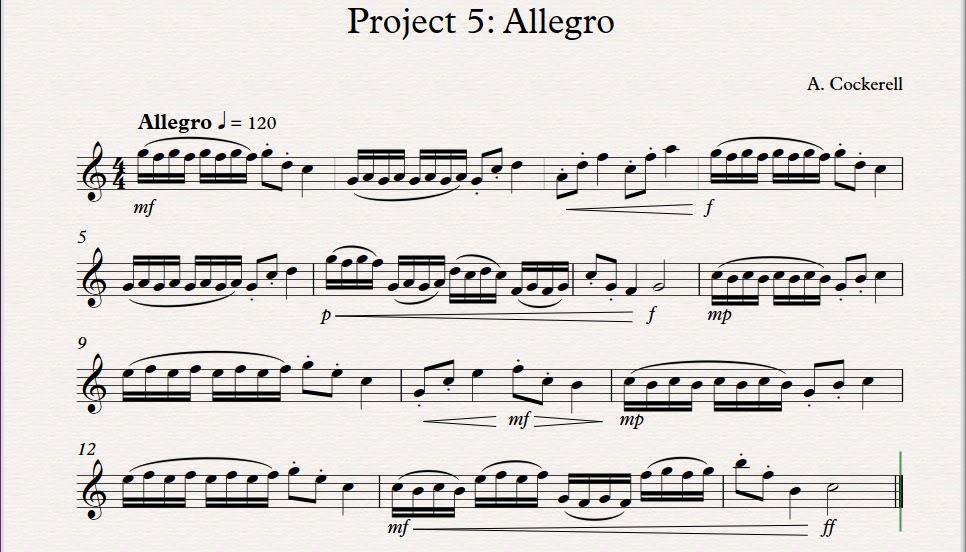
I was going for a flowing, bright sounding melody for soprano solo, something akin to an Alleluia, Amen or Hosanna solo. The slurred semiquavers are contrasted with staccato quavers. Again I played with sequences and inverting motifs.